In the cleaning and janitorial industry, your website is the digital face of your standards. A cluttered or outdated site sends the wrong message about the quality of your work. To win high-value contracts and recurring residential clients, your online presence must communicate professionalism, reliability, and an unwavering attention to detail.
Our design team evaluated hundreds of websites across the cleaning sector – including residential services, commercial janitorial firms, and specialized industrial cleaners. We analyzed these sites for user trust signals, transparent pricing structures, and seamless booking or quote-request flows.
Whether you are scaling a local maid service or managing a large-scale commercial cleaning enterprise, these 13 examples represent the benchmark for digital excellence in 2026.
Note on Our Selection Process: We recently audited this guide to remove outdated designs and sites that no longer meet our performance standards. This curated list now focuses on the top 13 cleaning company websites providing the most strategic value in 2026.
Top Cleaning Company Website Designs
1. Merry Maids
Why We Chose Merry Maids
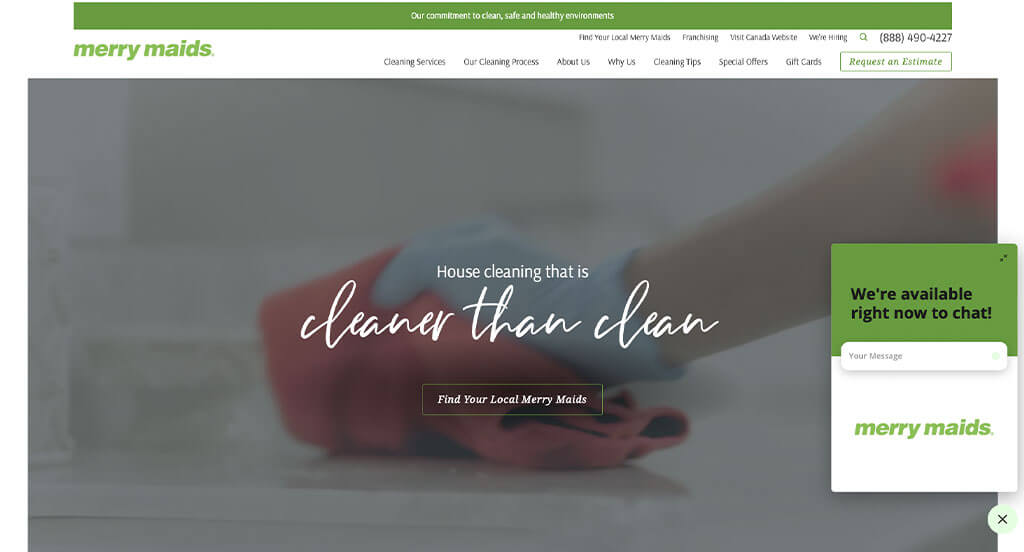
Merry Maids has to do something most local services don’t: sell a national brand while sending a local franchise to your door. The home page handles it by leading with scale – 40 years, two million services a year – then filling the middle with named customers and plain answers about what happens inside your house.
Key Design Highlights:
- Navy and Lime Green, Used as an Accent: The header and the band under the hero are deep navy, with the brand’s lime green reserved for buttons and small accents throughout the page rather than large blocks of color. Keeping it to that role means the green consistently signals “this is clickable,” and the restraint keeps a cleaning company from looking like a discount flyer. The italic serif headings and the photography of families in their own living rooms push it further toward warm and premium than functional.
- Roughly Twenty Customer Reviews on the Home Page: The testimonial section runs long and names individual cleaners – Deedee and JJ, Hailey and Chastity, Natasha, Ana – with the customer’s first name attached. For a franchise brand, that specificity is doing real work: it shows the reviews came from actual visits rather than corporate marketing, and it reassures someone about the people who’ll be in their house.
- FAQ Answering the Awkward Questions: Five questions sit near the bottom covering exactly the hesitations that stall a booking – whether cleaners are insured and bonded, whether the products are safe for pets and children, whether you can ask them to focus on specific areas, and how often a deep clean is actually needed. Answering these on the home page saves a phone call and settles the trust question before anyone has to ask it out loud.
- “Free Quote” Pinned in the Header: The button stays in the top bar across the site, alongside an 888 number and a “Find your local Merry Maids” link. The location link matters as much as the quote button here, since pricing and services vary by franchise, and routing someone to their local office early avoids a quote that doesn’t apply.
2. Maid Brigade
Why We Chose Maid Brigade
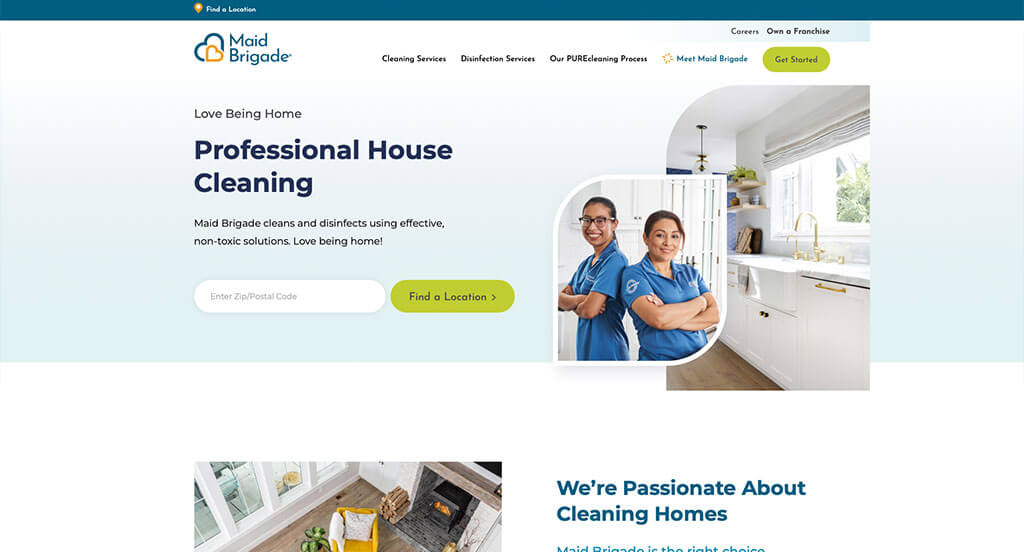
Maid Brigade never lets the estimate get more than a tap away. The button sits in the header, again in the hero, again mid-page, and on mobile it rides along in a fixed bar at the bottom of the screen. Around that, the page keeps to short sections with large photography rather than long explanatory copy.
Key Design Highlights:
- “Get An Estimate” in the Header and the Hero: The button appears in the top navigation next to the toll-free number, and again directly under the hero headline. Someone who arrives ready to book can act without scrolling, and someone who scrolls anyway hits the same button again further down the page, so neither reading style has to hunt for it.
- Google Reviews on the Home Page: A “What Our Customers Have To Say” section pulls live reviews in from Google rather than using hand-picked quotes. For a service where a stranger comes into your house, current third-party reviews carry more weight than anything the company writes about itself, and pulling them live means the section can’t go stale.
- Sticky Call and Estimate Bar on Mobile: On phones, two buttons stay fixed at the bottom of the screen, one to call and one for an estimate, no matter how far the visitor has scrolled. Most cleaning searches happen on a phone, and keeping both options in thumb reach means the decision to book never depends on scrolling back to the top.
- Slide-In Animations on Scroll: Sections ease into view as the visitor moves down the page rather than appearing all at once. It gives a fairly short page a sense of pacing, and it draws the eye to each service block in turn instead of presenting them as one undifferentiated list.
3. The Cleaning Authority
Why We Chose The Cleaning Authority
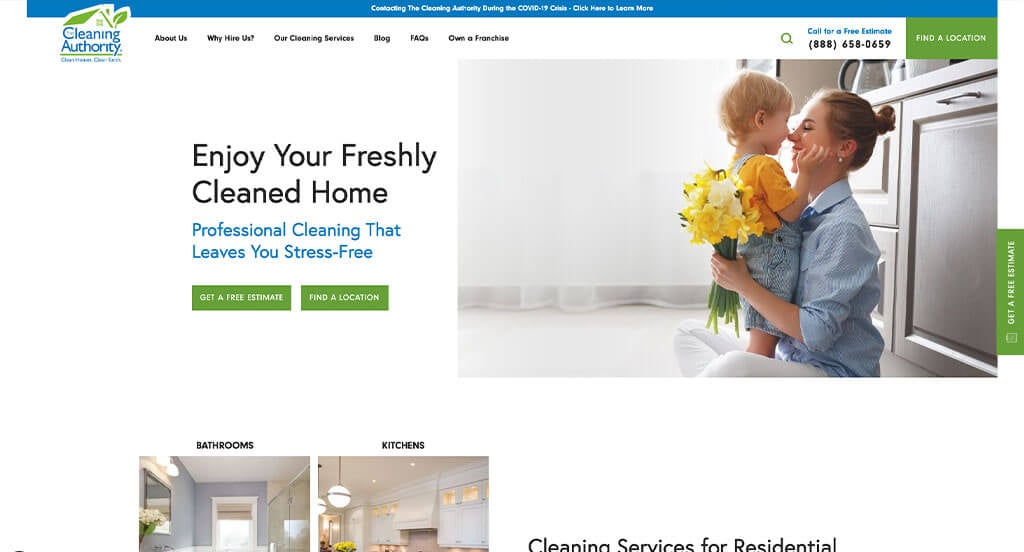
The Cleaning Authority builds its home page around one idea it owns outright: the Detail-Clean Rotation System, a named method for which rooms get deep-cleaned on which visit. Everything else on the page supports that claim, with pricing and location tools kept within reach at every scroll depth.
Key Design Highlights:
- “Find A Location” Given Top Billing: The green location button anchors the far right of the header, sized larger than the phone number beside it. Each office is individually owned, so pricing and available services vary by market, and routing a visitor to their local franchise first prevents a quote that turns out not to apply.
- “Get Pricing” Tab Fixed to the Screen Edge: A vertical pricing tab rides along the right side of the window at every scroll position, on top of the two buttons already in the hero. The company promises an immediate online quote rather than a callback, so the tab leads somewhere that actually returns a number instead of collecting an email address.
- The Detail-Clean Rotation System® Front and Center: The trademarked method gets its own section near the top, explaining that rooms are deep-cleaned on a rotating schedule so no area goes untouched for long, with icons for bathrooms, kitchens, living areas and sleeping areas plus a link to a full explanation page. Naming and trademarking the method turns “we clean thoroughly” into something specific a customer can evaluate, which is hard to do in a category where every competitor makes the same promise.
- Four Service Tiles With Plain Descriptions: House cleaning, apartment cleaning, move in / move out, and one-time cleans each get a tile with a one-line description and a link to a fuller page. Sorting by situation rather than by task means a renter facing a move-out inspection and a homeowner wanting biweekly service each land on the right page immediately.
4. eMaids
Why We Chose eMaids
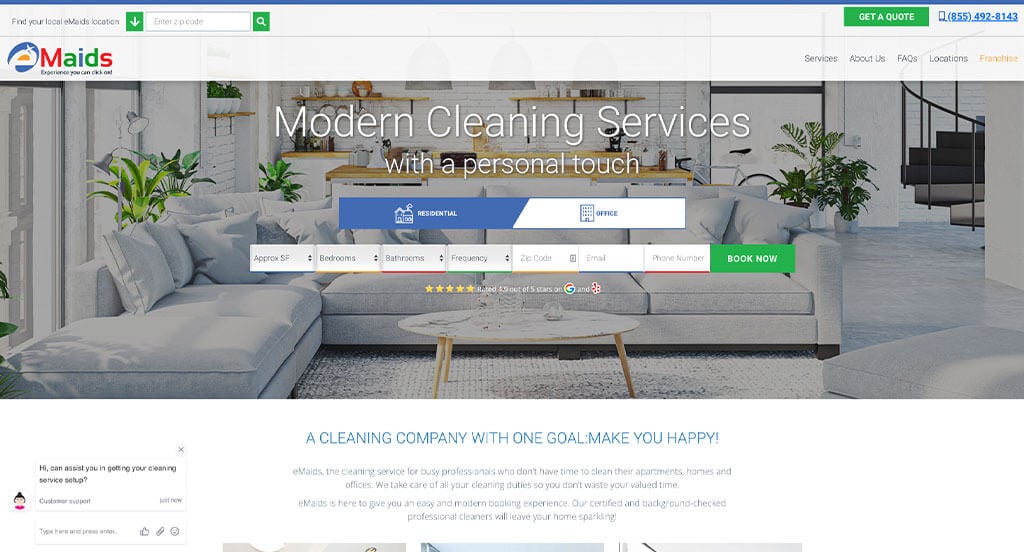
eMaids puts a quote form where most cleaning sites put a headline and a stock photo. Before scrolling, a visitor can specify square footage, bedrooms, bathrooms and frequency and get moving on a booking, and the rest of the page fills in the details that would otherwise stall the decision.
Key Design Highlights:
- Quote Form Built Into the Hero: The top of the page is a multi-field form with a residential/office toggle, dropdowns for approximate square footage, bedroom and bathroom count, and cleaning frequency from weekly to one-time, plus zip code and contact details. It also carries a reassurance line noting that bookings can be cancelled free up to 36 hours ahead. Asking for the house details up front means the quote comes back specific rather than as a range, and the cancellation note removes the risk of committing before you’re certain.
- Tap-to-Call in the Mobile Header: On phones, a call link sits in the header alongside the booking button, with the toll-free number repeated at several points down the page. The form suits people who want to handle it themselves, but the phone option keeps the door open for anyone with an unusual space or a question the dropdowns don’t cover.
- Six Service Tiles, Each With a Checklist Link: Home, office, vacation rental, post-construction, move in/out, and deep cleaning each get a photo, a full paragraph of description, and two buttons: “Book Now” and “View Checklist.” The checklist link is the useful part, since it lets someone see the actual task list for a service before committing, which is exactly the ambiguity that makes people hesitate to book cleaning online.
- FAQ Placed Just Above the Footer: Six questions sit at the end of the page covering property types served, how to request a cleaning, whether the standard checklist can be customized, whether cleaners are trained and insured, the 100% satisfaction guarantee, and discounts for recurring bookings. Positioning them at the bottom catches the reader who scrolled the whole page without converting, and answers the last few objections while the booking form is still one tap away.
5. Cottage Care
Why We Chose CottageCare
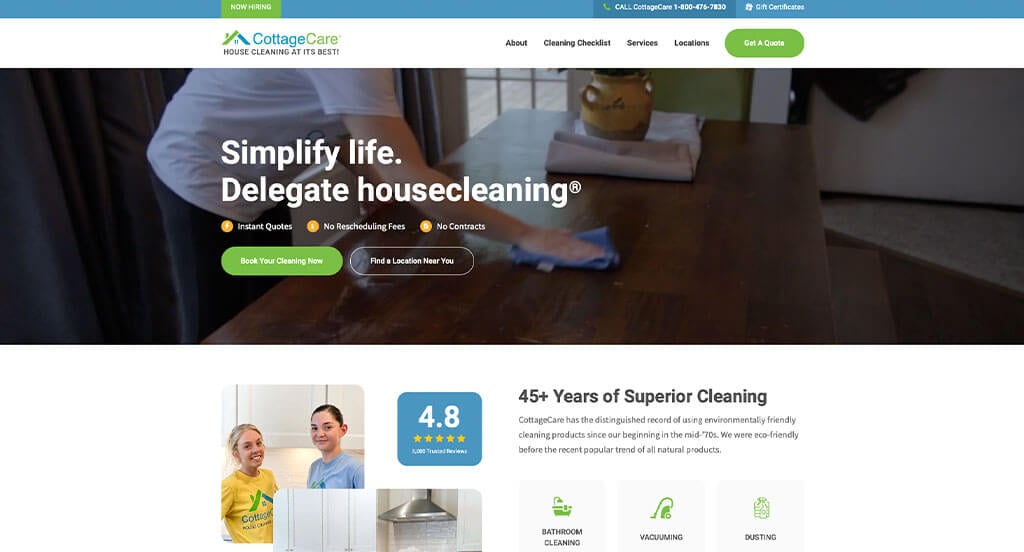
CottageCare has been at this since the mid-1970s, and the home page leans on that history: 45+ years, 40+ locations, a 4.9 rating across 11,000 reviews. What sets it apart from other national cleaning sites is how much space goes to things that aren’t selling, particularly a section on how the company treats its crews and where its charitable money goes.
Key Design Highlights:
- “As Featured In” With Working Links: Logos from Martha Stewart, Better Homes & Gardens, Southern Living, The Spruce, Apartment Therapy, Kitchn, Family Handyman and Homes & Gardens sit near the bottom, and each one links to the specific article the company was quoted in. Most sites stop at the logo, which asks the reader to take the mention on faith; linking through to the actual piece turns a claim into something checkable in one click.
- “Giving Back” Section With Three Distinct Commitments: The section covers crew wellbeing, community involvement through Habitat for Humanity and charitable fundraisers, and a charity the company founded for widows and orphans in Rwanda, which gets its own page in the main navigation. Leading with how they pay and train their own crews is the unusual choice, and it lands differently in a category where staff turnover is what usually goes wrong for the customer.
- Rotating Customer Testimonials: A carousel cycles through customer comments, backed by a stats band showing the 4.9 Google rating, 11,000+ reviews, 42 locations and 100,000+ customers. Rotating them keeps a large volume of feedback from consuming half the page, and pairing the individual comments with the aggregate number covers both the emotional read and the statistical one.
- Six Service Categories, Each With Its Own Page: Bathroom cleaning, vacuuming, dusting, kitchen cleaning, hard floor cleaning and tailored cleaning are listed as separate links rather than lumped into one description, with a “See Our Checklist” link nearby showing exactly which tasks are included. Sorting by room rather than by package matches how people actually think about what they want cleaned, and the checklist settles the question of scope before anyone requests a quote.
6. Maid Marines
Why We Chose Maid Marines
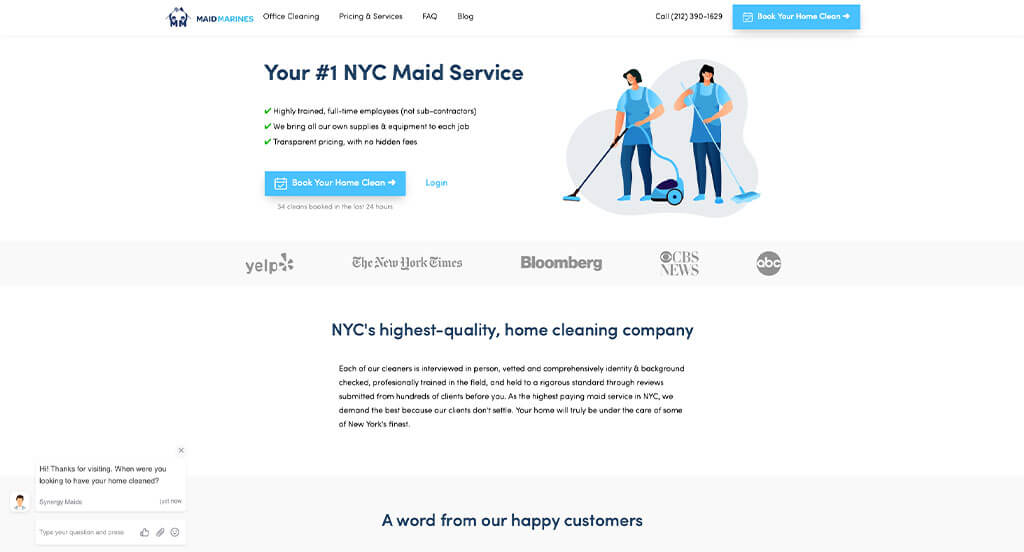
Maid Marines is built for someone who wants a price now, not a callback. The site promises a booking in 60 seconds, publishes exactly what’s included, and backs it with a 200% guarantee, then spends the rest of the page arguing why it’s worth more than the cheapest option in New York.
Key Design Highlights:
- Instant Price in the Hero, Booking Bar at the Foot: The top of the page leads with “Get Your Instant Price” and a booking link that promises 60 seconds and no credit card, and a persistent bar at the bottom of the screen keeps “Book Your Home Cleaning” available at any scroll depth. A live counter noting how many cleans were booked in the last 24 hours sits nearby, which quietly signals the system is actually in use.
- Screenshotted Google and Yelp Reviews: Rather than retyping quotes, the review section shows actual captured reviews from both platforms, with star ratings, dates and reviewer names visible. Screenshots are harder to fake than typed testimonials, and pulling from two platforms rather than one covers readers who trust Yelp and readers who trust Google.
- Everything Included, Spelled Out: A section lists what comes standard: an 85-point checklist, the same cleaner each visit, employees rather than gig workers, eco-friendly supplies brought to the job, and a same-day Certificate of Insurance for doorman buildings. Below it, a room-by-room breakdown covers bedrooms, bathrooms and kitchen, with paid extras like inside the oven or fridge listed separately so nobody is surprised at checkout. The COI detail is the standout, since anyone who’s tried to get a cleaner into a co-op knows that’s usually the sticking point.
- “Who Maid Marines is NOT For”: A section near the bottom says outright that they are not the cheapest cleaners in New York, and tells anyone looking for a cash-in-hand job from an uninsured app worker to hire someone else. Turning away part of the market is a real risk, but it makes every other claim on the page read as more credible, and it filters out the price shopper before they book and end up disappointed.
7. USA Clean Master
Why We Chose USA Clean Master
USA Clean Master offers more than twenty services across thirty-plus divisions, which is a lot to fit on one page. The site handles it with popups that hold the detail until asked for, city-by-city ratings that localize a national operation, and an FAQ that clears up the practical questions before anyone calls.
Key Design Highlights:
- Service Popups With Two Ways Out: Clicking a service tile opens a panel with a plain-language explanation – hot water extraction for carpets, fabric identification for upholstery, hidden mold detection for remediation – along with a “Learn more” link and an “Order service” button. The order button carries the service code with it, so the estimate form arrives already knowing what you picked. That covers the person who wants to understand the method and the person who just wants to book, without making either wait on the other.
- Google Ratings Listed City by City: Right below the hero, ten markets appear with their individual Google ratings and review counts: Rockville at 4.7 from 521 ratings, Tampa at 4.7 from 442, Baltimore at 4.8 from 421, Dallas, Atlanta, Fort Lee, Philadelphia, Washington DC and more, each linking to that city’s page. Breaking the rating out by location rather than showing one national average answers the question a visitor actually has, which is whether the crew near them is any good.
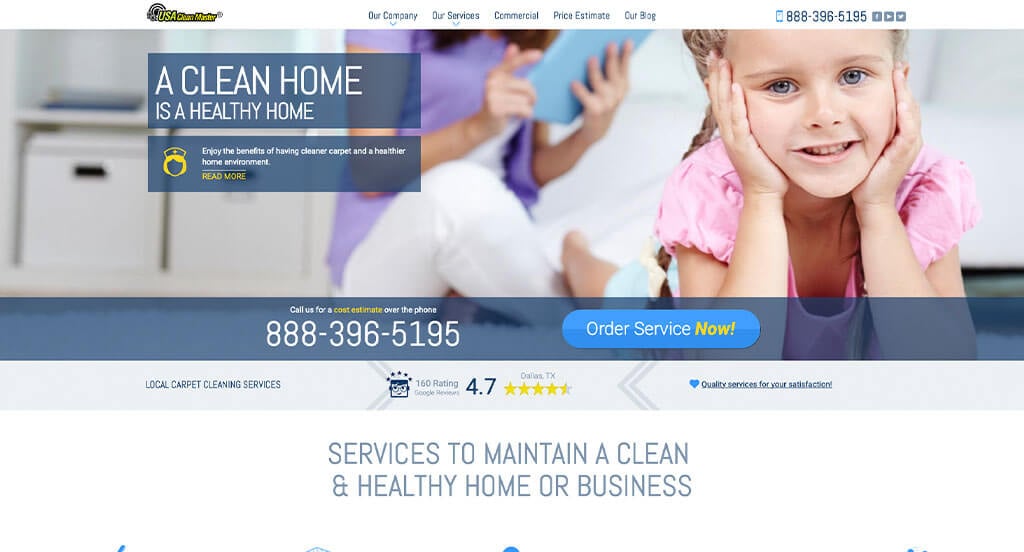
- Phone Number and “Order Service Now” Up Top: The toll-free number sits in the header with an “Order Service Now” button beside it, both repeated in the hero and again further down, with a WhatsApp link in the footer as a third route. The page also states that estimates can be given over the phone, so calling isn’t just a way to start a conversation – it’s a way to get a number.
- Seven-Question FAQ Near the Bottom: The questions handle the logistics that stall a booking: how often to schedule, whether stain removal is included in a general clean or costs extra, whether eco-friendly products are used, whether you need to be home, and whether you can book a specific time. The stain question is answered honestly rather than optimistically, noting that some stains come out with basic steam cleaning and others need more, which sets a realistic expectation instead of a promise the technician may not be able to keep.
8. Shine Window Cleaning
Why We Chose Shine Window Cleaning
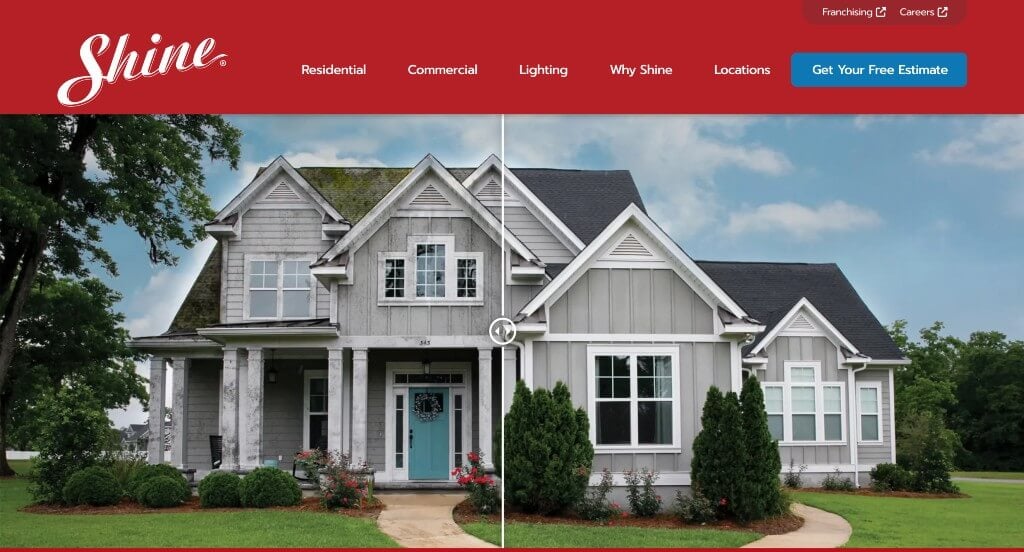
Shine sells exterior work that most homeowners put off because it involves a ladder. The site leans into that, laying out a three-step process, backing the work with a money-back guarantee, and showing enough review volume to make the decision come down to whether you’d rather spend the weekend on the roof yourself.
Key Design Highlights:
- “Get Your Free Estimate” Fixed in the Header: The button sits in the top navigation on every page, and repeats four more times down the home page, each time labeled as free and no-obligation. Exterior work is one of those services where people assume they’ll get pressured into a package, so restating the no-obligation part at every prompt is doing deliberate work.
- 100% Money-Back Guarantee, Stated on the Home Page: A dedicated section promises they’ll either make it right or refund the money if you aren’t satisfied, with a link to the full terms on the Why Shine page. Putting the guarantee on the home page rather than burying it in fine print shifts the risk onto the company, which matters for a service where the customer usually can’t inspect a second-story window or a roof to judge the work.
- Three-Step Process With Named Steps: “Take Your Property from To-Do to Ta-Dah!” breaks the process into getting an estimate, scheduling a time, and having the crew arrive, each with an icon and one line of explanation. Three steps is about as simple as a process diagram gets, which suits a service most people have never hired before and assume is more complicated than it is.
- Reviews Backed by a Total Count: Three full customer reviews sit mid-page alongside an aggregate badge showing 4.8 stars across 5,478 five-star reviews. The individual reviews mention specifics that matter for this trade, like pure water systems and reaching two-story coach lights, while the aggregate number establishes that the three weren’t cherry-picked from a small pool.
9. Men In Kilts
Why We Chose Men In Kilts
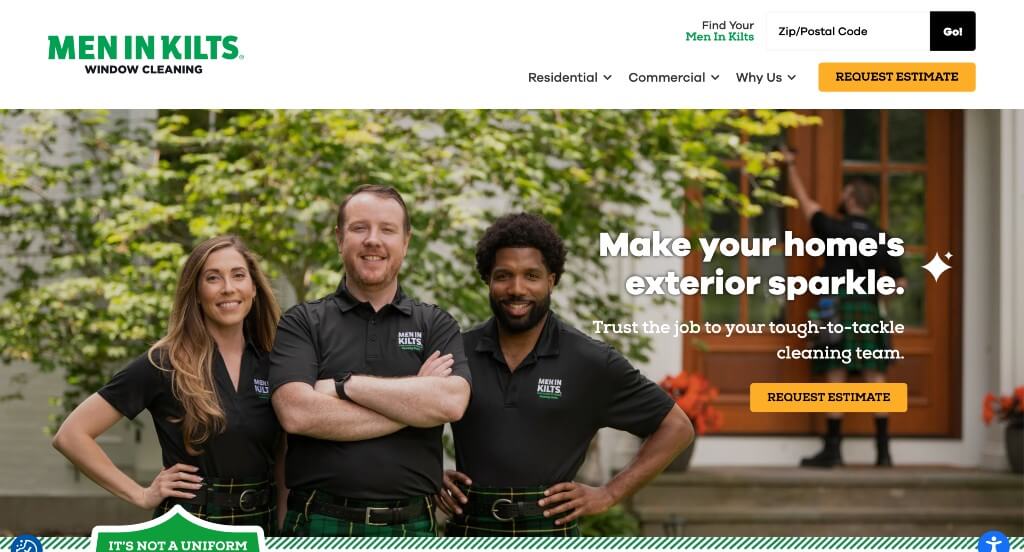
Men In Kilts has the most memorable premise in exterior cleaning, and the site is smart about not resting on it. The tartan is everywhere, but so are gutter cameras, ladder safety protocols and a 48-hour guarantee, so the novelty gets you to read and the specifics get you to book.
Key Design Highlights:
- Clickable Scene With Service Hotspots: A residential and a commercial illustration each carry clickable figures, prompted by a “Click an icon to see us in action!” label, and selecting window cleaning, gutter cleaning, house washing or pressure washing swaps the scene to show that job being done. It puts the services in the context of an actual property rather than a list, which helps someone who isn’t sure whether their problem is a house washing job or a pressure washing one.
- Brand Identity Carried Through to the Guarantee: The “What sets us apart” section runs on the tartan theme and lands on the “plaid promise,” a 48-hour Kilt Clean Guarantee: report any area you’re unhappy with within two days and they re-clean it free. The same section names concrete practices alongside it, including a three-point ladder touch policy and commercial-grade equipment. Attaching the joke to a real commitment is what keeps the kilts from reading as a gimmick.
- “Request Estimate” in the Header and the Hero: The button sits in the top navigation and again below the hero headline, paired with a zip code lookup that routes visitors to their local franchise. The zip field matters as much as the button, since it puts someone in front of the team that will actually show up rather than a national form.
- Reviews With Names and Cities: Four customer reviews rotate mid-page under a 4.8 rating, each attributed to a first name and hometown: Lexington, Richmond, Miami, Fort Collins. The geographic spread does double duty, showing the service is consistent across markets and letting a reader find one from a climate resembling their own, and the reviews name specifics like 20-foot windows and old hard water stains rather than just saying the crew was nice.
10. The Maids
Why We Chose The Maids
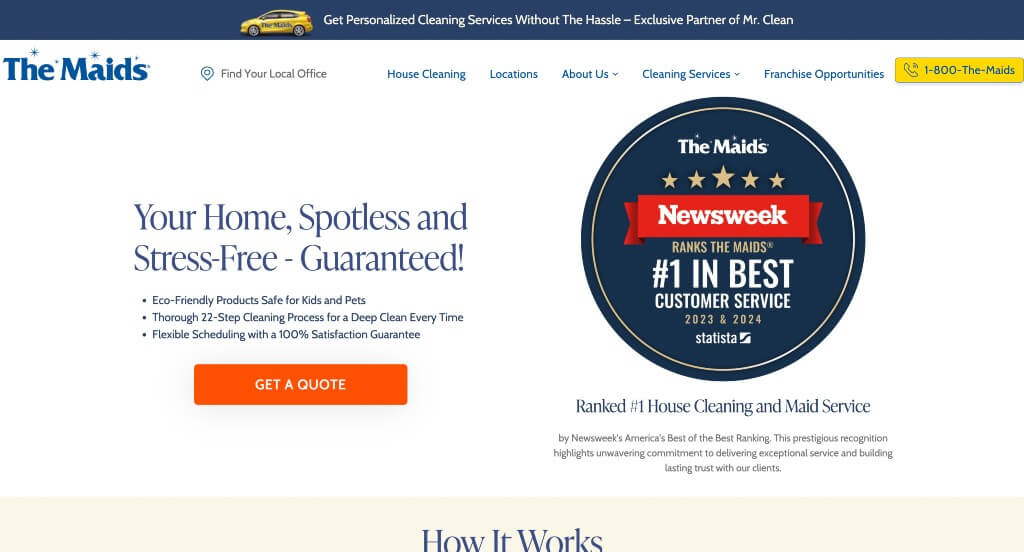
The Maids runs nearly 200 franchises, so the site’s main job is getting a visitor to the right local office with the right plan already picked. It does that with named tiers sorted by how many rooms get cleaned, popups that keep twenty services from becoming twenty page loads, and a 22-Step Cleaning Process referenced at nearly every turn.
Key Design Highlights:
- Plans Sorted by Rooms Cleaned: Core covers three rooms, Essential covers five, and Ultimate covers the whole house, with an Ultimate Plus tier in some markets, each with a line describing who it suits – condo dwellers, packed-schedule families, households with kids, pets and allergies. Clicking a plan expands the full room list, with items outside that tier shown but not included. Pricing cleaning by room count rather than by hour or square footage is unusually legible, and letting someone see what the next tier up would add makes the upgrade an informed choice rather than an upsell.
- Twenty Services, Each in a Popup: The service grid runs from deep cleaning and move-outs to Airbnb turnovers, post-renovation and cleaning for pet owners, and clicking any icon opens a panel with specifics: HEPA filtration capturing up to 99 percent of airborne contaminants, EPA-approved disinfectants, gloves and shoe covers. Each panel ends with a quote button and a link to the full page. It’s a lot of information to hold without the popups, and the two-button ending covers both the reader who’s convinced and the one who wants to keep reading.
- Quote Button and Phone Number in the Header: Both sit in the top bar in high-contrast styling, alongside a location finder that asks for an address before anything else. Routing by address first is the right call for a franchise network this large, since services and availability vary by office, and it means the quote a visitor gets is the one that actually applies.
- Blog Posts Written for Specific Cities: The homepage surfaces six recent posts, several aimed at particular markets: protecting floors from ski boots in Denver, keeping a fireplace clean in New England, prepping a home for Minneapolis winters. Local angles give a national brand something to say that a generic cleaning-tips post can’t, and they pull in search traffic from the exact markets where the franchises operate.
11. The Pampered House Maid Service
Why We Chose Pampered House
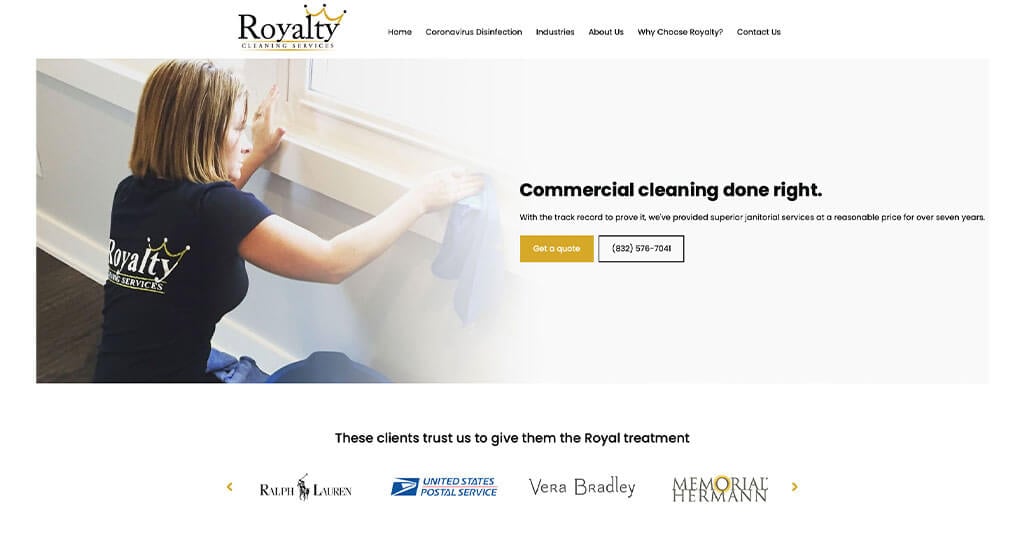
Pampered House has served Tarrant County since 2001, and the site reads like a company that knows its customers by name. The strongest thread is the home profile: a room-by-room record of how you want things done, built during an in-person walk-through, so any maid who shows up already knows your preferences.
Key Design Highlights:
- A “Cleaning Menu” of Seven Services: Residential, deep cleaning, post-remodeling, apartment, office, move-in/move-out and priority cleaning are each listed as their own item with its own page. Calling it a menu rather than a service list sets the expectation that you’re assembling something for your situation rather than buying a fixed package, which matches how the walk-through process actually works.
- Phone Number in the Header on Every Screen: The number sits in the top bar and again in the mobile menu, and the copy explicitly tells you to start with a call rather than a form. For a local company where the owner may answer, pointing people to the phone first is the right call, and it’s a real point of difference from the national chains that route everything through an online quote tool.
- Web Specials Tied to Reviews and Referrals: A slide-out panel labeled “See Our Specials” offers $10 off for leaving a review on Google, Yahoo or Yelp, $20 off for referring a friend, and a free cleaning once a referred friend reaches their third visit. Tucking it into a panel keeps the discounts from cluttering the page, and tying the incentives to reviews and referrals grows the two things a local service actually runs on.
- Contact Form Beside an Explanation of the Walk-Through: The form sits next to copy that lays out exactly what happens: a call to discuss needs and pricing, a rough estimate based on square footage, then an in-person walk-through where they go room by room and build a custom profile for the home, down to how you like your throw pillows arranged. Spelling that out beside the form removes the main unknown, which is what you’re actually agreeing to when you fill it in.
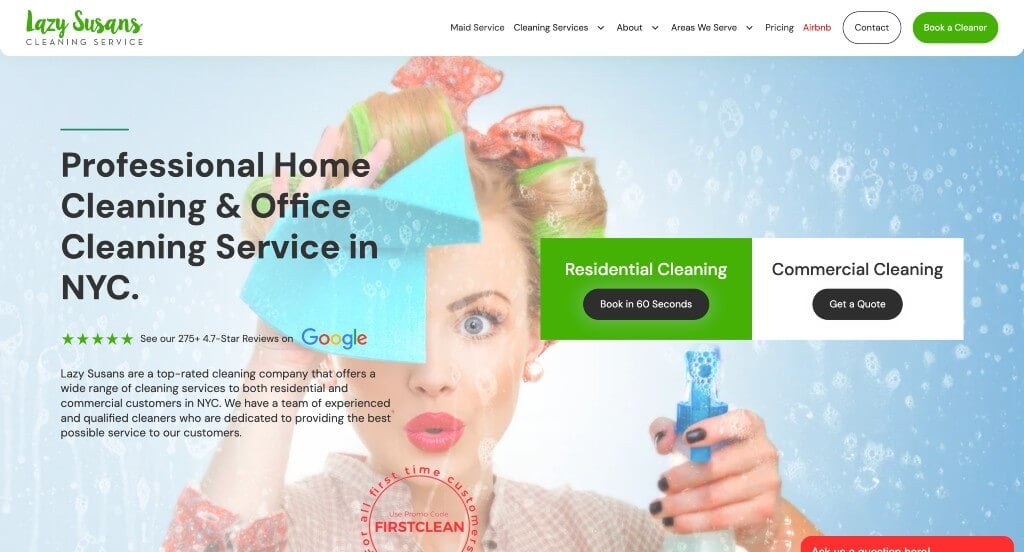
12. Lazy Susans Cleaning Service
Why We Chose Lazy Susans Cleaning
Lazy Susans does something almost no cleaning site does: it puts actual prices on the home page. Combined with a booking tool that promises 60 seconds, a service list running past thirty categories, and a staffed chat window, it lets a New Yorker settle cost, coverage and availability without ever picking up the phone.
Key Design Highlights:
- Flat Rates Published on the Home Page: Three pricing cards show real numbers: $142.08 for a weekly one-bedroom with tax, $171.47 for a two-bedroom, and $65 per hour per cleaner for custom work with a three-hour minimum, each listing the one-time, biweekly, three-week and four-week rates underneath. A promo code for 10% off a first clean sits in the hero. Nearly every competitor makes you request a quote, so showing the frequency tiers side by side lets someone see exactly what committing to a schedule saves them.
- Service Tiles Backed by a Full Text List: Six illustrated tiles cover the main categories – residential, move-in/move-out, Airbnb turnaround, hourly custom, commercial, post-renovation – and further down, a text list runs through more than thirty specific services, from balcony and wall cleaning to church, hospital and automotive dealership work. The tiles handle the visitor who’s browsing; the list catches the one searching for something oddly specific, and each entry has its own page.
- Staffed Live Chat: A chat window opens in the corner stating they’re live and typically reply within a few minutes. For a company promising same-day availability, a real person on chat is what makes that promise checkable, and it catches the visitor whose question – a walkup, a specific date, an unusual space – isn’t covered anywhere in the copy.
- Google Reviews at the Top and Testimonials Below: The hero opens with a badge citing 280+ reviews at 4.5 stars, linked directly to the Google listing, and four full customer reviews appear further down naming specifics like a cleaner who wiped down an air conditioner unasked. Leading with the aggregate and following with individual accounts covers both the reader who wants a number and the one who wants to know what the visit is actually like.
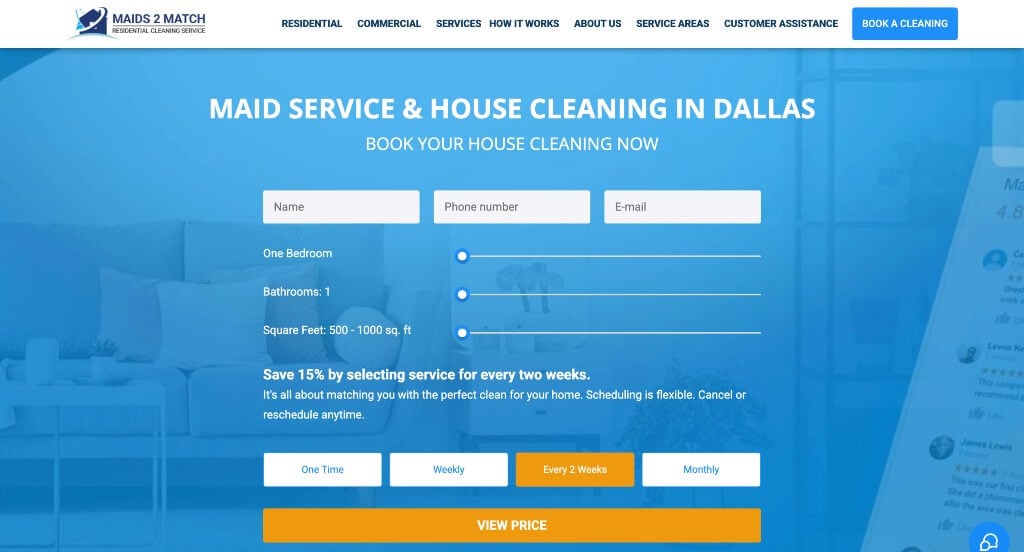
13. Maids 2 Match
Why We Chose Maids 2 Match
Maids 2 Match puts a working price calculator where most sites put a headline. Enter your details and the page returns a per-clean figure before you’ve scrolled, then spends the rest of the page backing that number up with vetting standards, a service map, and reviews.
Key Design Highlights:
- Instant Pricing Built Into the Hero: The top of the page is a live booking tool rather than a contact form, returning a per-clean price on the spot along with the total after the first service, with a first-time discount code applied at checkout. A note beneath it says scheduling is flexible and you can cancel or reschedule anytime. Turning the landing page into a calculator answers the only question most visitors arrived with, and the no-commitment line removes the reason to hesitate before trying it.
- Service Map With Suburbs Named: An embedded Google map sits alongside a list of covered communities – Addison, Garland, Grand Prairie, Plano, Frisco, Richardson and more, each with its own page – plus a phone number for anyone whose town isn’t listed. The map settles coverage visually for a metro as sprawling as Dallas-Fort Worth, and the invitation to call rather than guess catches the edge cases at the boundary.
- Seven Service Tiles With Photos: Move-in, move-out, standard, deep, recurring, apartment and condo, and commercial cleaning each get a photo and a sentence explaining who the service suits. Sorting by situation rather than by task means someone facing a move-out inspection and someone wanting biweekly upkeep both land in the right place without reading through the others.
- Testimonials Placed Directly Before “Why Customers Choose Us”: Customer reviews run immediately above a six-point section covering no contracts, vetting through identity checks and in-person interviews, and a promise to fix anything you flag by the next business day at no cost. Putting the outcomes ahead of the claims is the right order, since a reader who has just seen what customers say is more inclined to believe the vetting standards that follow.
WordPress Cleaning Themes
You can find free themes at wordpress.org, or explore cleaning-inspired templates at ThemeForest.
We Clean – Themeforest
$69
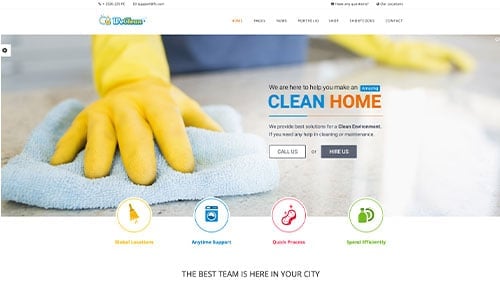
Cleaning Service – Themeforest
$59
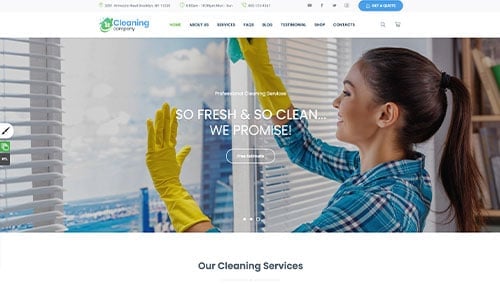
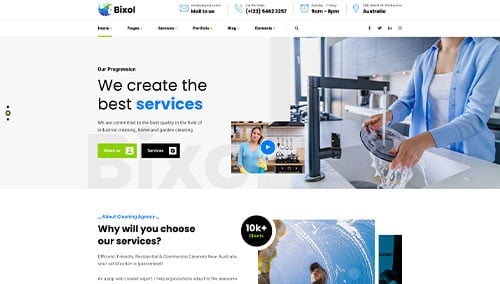
Bixol – Themeforest
$48
CleanMate – Themeforest
$69